 Lance Singbeil
Published: July 10, 2026
Eighty-three percent of small businesses now have a website, up from 64 percent in 2018. Most businesses clearly see the value in having one. Far fewer can say what that value is and knowing that value should be your priority.
A website audit can help define that value: a review of how your site is built, what it says and how visitors use it. Audits come in two forms. One is free and immediate. The other costs money and takes some time. Which one is the right one for you?
A free audit can confirm that something is wrong or reassure you that the basics are in place. That has real uses, and there are moments when it’s exactly the right move. It will tell you something needs attention, the way symptoms do but rarely tells you what to improve or how.
Knowing whether your website is returning value takes more than a symptom check. It takes someone with the experience to understand what your site is supposed to do for your business, and the judgment to assess how well it’s doing it. That’s the work of a paid audit.
This article lays out what each kind of audit gives you, so you can tell when a free one is the right starting point and when finding real answers requires the deeper work.
What you can reasonably expect from a free website audit
Free audits come in two forms: automated technical scans or professional reviews that add a layer of judgment on top of the scan.
Automated scans
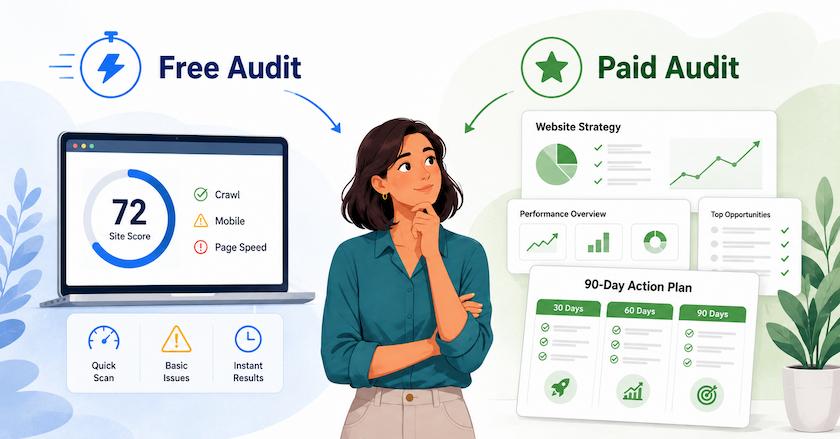
Automated scans work this way. You enter your URL, a tool crawls your site checking things like page titles, meta descriptions, broken links, image sizes, accessibility, search visibility and mobile responsiveness, and within seconds you get a score and a list of flagged issues.
Tools like this can check well over a hundred individual data points and are genuinely useful for spotting things a busy owner might miss, like a missing meta description on a key page or a broken link that’s been sitting there for months.
These tools are honest about their own limits. Even the companies that build them tend to describe their free scans as a starting point, useful for surfacing visible technical issues. Free tools like Lighthouse work the same way. It will evaluate a page’s performance, accessibility, best practices or SEO structure but it doesn’t put the page in context to how it matters to a customer.
Professional review
The second form comes from an agency or web designer, and it delivers more than the scan alone. The reviewer typically runs the same automated tools, then adds insights: a look at your design, your content and how a visitor would move through the site, shaped into recommendations based on experience.
That judgment is real value, and it’s worth taking when it’s offered. It still has limitations. The reviewer is working from observations only: your pages, your load times, your visible content. They don’t know which services are most profitable to you, which inquiries you value most or what your site is supposed to be producing for the business.
The reality
Automated scans are something you can run yourself. In fact, they’re a good habit to get into. The tools are free, they take minutes, and a periodic scan, quarterly or after any significant site change, catches technical problems that can go unnoticed for months. No agency required.
The professional review works differently. Someone invests time on your website with the intention to get to know you. They are showing you how they think, hoping to open a conversation about working together. What you need to consider is whether the value you expect from the review is worth that conversation. A good review should be an easy yes. It should give you something useful regardless of the next steps. It should earn the provider the only thing a free review should be selling: a reason to trust them with more.
What a free website audit can’t see
A good free website audit will catch the technical issues, apply real experience and hand you sensible recommendations. So, what’s missing compared to a paid audit?
What’s missing is context. The free audit will analyze your website without a full consideration of the business behind it. Who is the business’s clientele? Which channels bring them to the website? What tasks do they want to complete once they arrive? What can you realistically maintain to keep the site working, and how would you measure its success? A paid audit should start with a clear understanding of the business and frame the audit around these questions.
Businesses arrive at these questions from very different starting points. Some have no real measurement in place and judge the site by traffic counts and compliments. Others track their numbers closely; know their priorities and can already name the changes they suspect are needed. A paid audit serves both, differently. For the first, discovery builds the foundation: what to measure and why it matters. For the second, the value is an outside reading of the site against priorities you already hold, and a disciplined sequence that turns what you suspect into work you can commit to.
Discovery: the work behind a paid audit
Understanding the business is built through discovery. The auditor needs to learn your business priorities and how you win customers. They’ll review the site both as a visitor experiences it and against what the business needs it to do. The gap between those two views is where the audit’s value lies. You provide what no outside reviewer has: analytics access, honest answers, time for real conversation. This is the work you’re paying for.
Take a manufacturer whose website has three priorities: generate sales leads, let customers order product online and attract new distributors. The work of the paid audit should evaluate the site against each priority. Whether the messaging addresses a buyer, a customer and a prospective distributor. How each group moves through the site, and what conversions those paths lead to: a submitted form, a completed order, a distributor inquiry.
Each finding carries a business consequence. A page that sits three clicks from the home page could create friction for the visitor. When that page is the distributor page, and growing the distributor network is this year’s priority, a weak conversion path becomes one of the most important findings in the audit. A useful finding identifies the weakness, what it costs the business and why it should be fixed first. Those opportunities for improvement become the foundation of the plan.
How much does a paid audit cost?
The market pricing for paid website audits is fairly consistent. Audits under roughly five hundred dollars are widely described as automated or template-driven, often by the agencies selling them. Real discovery and a prioritized plan consistently show up in the range of fifteen hundred to three thousand dollars. That pricing reflects how hard the work is.
Only 52 percent of senior marketing leaders can prove marketing’s value and get credit for its contribution to business outcomes. These are people with teams and analytics platforms behind them. A paid audit doesn’t solve that whole problem, and no one should claim it does. It does something narrower: it ties specific fixes on your website to specific numbers your business already watches. Below five hundred dollars you’re buying a report. Above fifteen hundred, it’s an investment. Expect a return.
What should you be paying for?
You’re paying for the plan, not the fixes. The work itself is a separate expense, and the plan is what makes that expense accountable: each opportunity for improvement converted into a piece of work, scoped, sequenced and tied to the metric it should move. You can see what each piece should return before you commit money to it, and budget the work on your own terms. Almost anyone can perform a fix. Knowing which fixes matter, in what order, and why: that judgment is what the fee really buys.
A paid audit should end with more than a list of problems. Even a prioritized list only tells you what’s wrong. A plan tells you where to invest, what changes are needed and how those changes will be sequenced, typically across ninety days.
The plan’s priority is groundwork: identify whatever is blocking or confusing visitors and set the metrics before any other work begins. From there it lays out the work on the pages that produce results. For our manufacturer example, the plan would specify rebuilding the distributor page, the inquiries it should generate from the target audience, and the numbers that will confirm it: leads, orders, applications. Each piece of work is scoped so you can see the effort involved. Some you’ll handle in-house based on your capacity, some need a developer or a writer, and some may be work the auditor quotes separately.
This is the deliverable I aim for in my own Website Audit & Discovery work, and it’s the standard any paid audit should work towards. If an audit hands you findings and stops, even ranked ones, you’ve paid for a more detailed version of the free scan. A real audit hands you the judgment and the plan that carries it out. Work the plan, and ninety days in you should see movement in the numbers the plan targeted. Some fixes register quickly. Work that depends on search visibility takes longer, and an honest plan says which is which.
How do I decide which one is right for me?
If you want to know whether anything technical is obviously an issue, run a scan yourself, make it a habit, or accept a professional review when it’s offered and weigh what comes with it. Either way you’ll learn something useful at no cost beyond a little time.
If the question is “How do I get more business from this website?”, no free review can answer it, no matter how good. That answer requires understanding the business first: what the website is supposed to produce, which weaknesses cost you most and what each fix should return. That’s the discovery work you pay for, and it leaves you with results you can act on: specific numbers, tied to specific work.
And if you already know your website should be doing more, and you want the plan that shows where to invest, start with my Website Audit & Discovery service. Discovery first, priorities weighed by what they’re worth to the business, and a sequenced ninety-day plan you can budget against and act on.
If you’re not sure, that’s the question my complimentary Website Value Snapshot exists to answer. It’s a short, focused look at where your website may be limiting the value it should be creating for your business, and an honest take on whether a paid audit is worth your money. If it isn’t, you’ll know that too.
Ready to know what your website is worth?
A Website Audit & Discovery starts with your business and ends with a plan you can budget against and act on. If you’d rather start smaller, let’s talk about where your site’s value stands now.
Explore Website Audit & Discovery Start a conversation