 Author: Lance Singbeil
Published: August 12, 2026
For a small business, a website redesign can become a substantial investment quickly. The site may clearly need work, but that does not necessarily mean the whole thing needs to be replaced. But before committing to a full redesign, it is worth asking whether the site needs to be rebuilt, refreshed, or improved in a more targeted way.
That means looking beyond appearance. If the site is generating weak inquiries, making important information difficult to find, or creating unnecessary maintenance work, the first step is to understand what is causing the problem and how far it extends.
Otherwise, you risk spending a limited budget on visible change without fixing what is actually holding the website back.
When a redesign becomes unavoidable
Sometimes you don’t have a choice. When the business and branding have dramatically changed a redesign is viable option. If the structure has become too complex and the navigation is cumbersome, rebuilding will help. If the technology is outdated or it makes updates difficult it’s time for a change.
But whatever forces the decision, it should rest on evidence and business goals rather than appearance. If the foundation is at fault, continuing to patch it is not the economical choice.
Diagnose the problem before doing the work
So how do you determine the condition of your foundation? What determines whether you rebuild or implement targeted improvements?
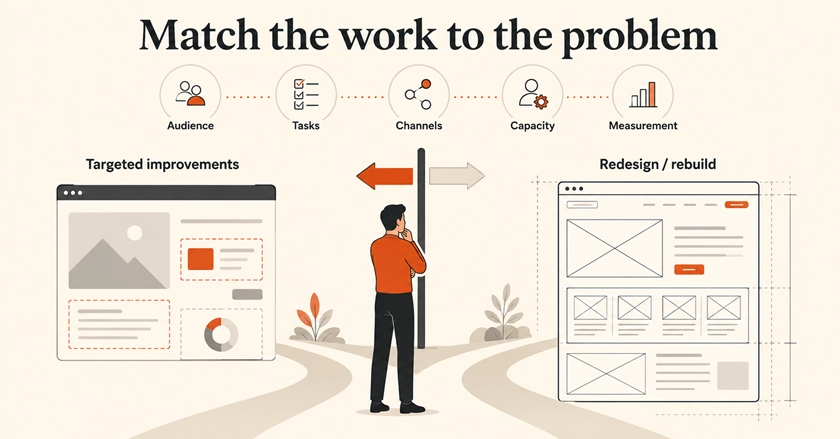
At Pharos Internet, I assess those two questions through five connected pillars: Audience, Tasks, Channels, Capacity and Measurement.
Audience: are you attracting the customers you want?
Start with the people the website is meant to support. Audience fit helps show whether the site needs clearer messaging or more substantial change. Plenty of traffic can still be a problem if visitors are arriving for the wrong services or with expectations the business cannot meet. The site may also describe the business in internal terms instead of language customers use.
To understand your audience, compare the customers the business wants with the visitors and inquiries the website produces. Review inquiry quality, search terms, customer questions and the words prospects use before they make contact.
If the audience fits but the message is not clear, targeted page improvements may be enough. If the business is trying to reach different people, the site’s structure and messaging may need to change.
Tasks: can people accomplish what they came to do?
A task is what a visitor is trying to accomplish on your website: deciding whether a service fits, checking your credibility, answering a practical question or working out whether to contact you. The business has tasks too, from generating qualified inquiries to directing existing customers to the right resources. A useful website connects both sides.
Incomplete tasks show up where visitors hesitate or drop off. A service page explains your work but doesn’t help someone take the next step. Basic questions are still asked by phone because the site never answers them clearly.
To find the tasks that matter, walk through your most important client journey, often the path from a service page to an inquiry. Do this as a first-time prospect on your phone and note where you have to guess. Then improve the path: answer the natural questions, put information in a useful order, remove distractions and offer a next step that matches their readiness.
If one important journey is weak, focused work is enough. If visitors struggle across several, the structure and navigation need reconsidering.
Channels: does the site support how people now find you?
A channel is where you build awareness and interest in your business: search, referrals, social activity, directories and now AI assistants. Different audiences use different channels, so think about where your audience “lives.” A homeowner looking for a tradesperson asks neighbours and checks Google Business Profiles. Community interest gathers in Facebook groups, professional buyers vet contractors on LinkedIn and someone comparing products may ask their favourite AI for advice.
The channel delivers the visitor to a specific page, and the page should pick up where the channel left off. A visitor from your Business Profile has already seen your reviews and location, so the page should confirm service details and make contact easy rather than reintroduce the business. Get that wrong and the channel’s work is wasted.
To see which channels are working, trace your last twenty inquiries back to their sources and note which produced prospects rather than visits. To learn where your audience lives, ask new customers where they found you; some of those places never appear in your analytics. Putting your prospects’ questions to an AI assistant shows whether you’re cited when it answers; how well it represents you is a subject for another article.
Often the fix is a better landing page or content aligned with a particular search intent rather than a new site. The priority is the channel that produces the best inquiries rather than the one that produces the most visits.
Capacity: can the business sustain the proposed solution?
Every page you publish costs manpower to create and maintain. Service details get out of date. Staff pages stop reflecting the current business. Without a review process, nobody notices until a customer does. Capacity is how much of that work your business can realistically perform, and the site stays alive only when the workload fits inside that capacity.
The evidence is usually already visible on your site. A news or blog section whose last post is over a year old, or the same content copied and pasted across pages so that one change now has to be made in four places. There may also be a feature someone loved at launch, an events calendar or testimonials section, sitting empty because it was done off the side of a desk. Each of these is work that exceeded the capacity of the business.
Many capacity problems can be fixed without a rebuild. Consolidating duplicated content so an update happens in one place, or removing a section nobody maintains, costs an afternoon. A simple review cadence, an hour each quarter to catch what’s incorrect or outdated, costs less than any redesign project. If a refresh, redesign or rebuild is happening anyway, build the publishing improvements into it rather than carrying the old habits into the new site. And when a new feature or content idea comes up, question how you’ll keep it going month over month.
I see this cycle often: rebuild, neglect, decline, rebuild again four years later. A site scoped to the capacity behind it breaks the cycle.
Measurement: how will you know it’s working?
Measurement starts with what your business values. A firm that lives on referrals may value reviews from an existing client. A professional practice already near capacity may value fewer but better-qualified prospects instead of more traffic. Success is defined by the business first and quantified second.
The tasks you identified earlier are where the metrics come from. If a high-value task is a prospect moving from a service page to an inquiry, then the measure is how many inquiries that page produces and how many of them were worth pursuing. Each important task should have a metric that shows whether it’s being accomplished. Connect these metrics to a dollar value and the site’s contribution to revenue stops being guesswork.
From there, measurement becomes a reporting habit. A short monthly look at the same few numbers is enough to report whether the site is producing what you value. The same habit shows trends, separating a bad month from a real decline. It surfaces the changes that need attention, like a service page whose inquiries stopped after an update.
This is also what makes any changes you’re considering accountable. Eight months after a $30,000 redesign, the new site will look better, for a while. How do you gauge whether the money was well spent? You compare how the site produces against the baseline you recorded before the work, task by task. Nielsen Norman Group’s guidance on major redesigns points the same direction: ground the decision in evidence and measurable goals rather than visual dissatisfaction.
Before you make a decision on a rebuild, refresh, redesign or proportional improvements collect the data and determine the measure of return.
Match the work to the problem
Once the diagnosis is clear, the scope follows. The choice between a website refresh and redesign or targeted changes becomes easier when you know how far the problem extends. If you’ve looked at the site through the five pillars, you should have a clearer idea of where to focus the work.
You’ll usually end up in one of these buckets:
Improve selected core pages
This is the scope when the problems concentrate in a few high-value pages or one important visitor journey. The homepage may not explain the business clearly, or a service page may attract attention without helping prospects decide.
Pharos Core Page Improvements package focuses on the content closest to a business result: clearer positioning, stronger service explanations, improved content hierarchy, more useful proof and a better next step. On a small budget, improving several commercially important pages will usually return more than spreading superficial changes across the whole site.
Refresh the website and content
The middle ground is when the weaknesses are connected and the technical foundation remains viable. Navigation needs simplifying, service information has become inconsistent or outdated content makes the business difficult to understand.
Pharos’s Website Refresh & Content Strategy treats the site as one connected content system: revised priorities, reorganized content, improved visitor paths, updated presentation and more consistent page structures.
Redesign or rebuild the site
A redesign becomes appropriate when the experience no longer supports who the site is for and what visitors come to do. A rebuild becomes necessary when the technical foundation stops you completing required work. Keeping the decisions separate will stop you paying for new technology when the primary issue is content or placing a new design on a platform that will stay expensive to maintain.
These two options have a cost that’s rarely considered. Beyond the quote, a rebuild will resets your search equity and your measurement history. Those losses are recoverable with planning, but you pay for them regardless of how a rebuild solves the original problem.
My Purposeful Website Design work shapes a new site using evidence uncovered from the diagnosis. Structure, content priorities, visual direction and platform changes are driven by this. Baseline measurements are recorded and business metrics are defined so that the cost and benefits of a redesign or rebuild are tracked.
Sometimes you don’t have a choice. When the business and branding have dramatically changed a redesign is viable option. If the structure has become too complex and the navigation is cumbersome, rebuilding will help. If the technology is outdated or it makes updates difficult it’s time for a change.
But whatever forces the decision, it should rest on evidence and business goals rather than appearance. If the foundation is at fault, continuing to patch it is not the economical choice.
Working with a limited budget
A limited budget works best when it attacks the most important obstacle or reduces the greatest uncertainty.
The website redesign cost is more than the quote for design and development. Planning, content writing, staff time, migration, testing and ongoing maintenance all contribute to the real cost of the work. Those costs should be weighed against the value of the problem being solved. If better-qualified inquiries, easier maintenance or stronger sales support are the expected return, the investment should be weighed against those outcomes.
If the five questions above gave you a clear list of what needs to change, spend your investment on the things that will have the most impact on your business.
The work can also proceed in stages. Improve one group of core pages or one customer journey, then review the metrics you’ve set up and decide what to do next. The results may justify extending the work or reveal that the foundation is more limiting than expected.
The principle underneath all of it:
Reduce the scope before reducing the quality of the work.A smaller budget can lead to incremental changes completed properly. A Pharos Website Audit & Discovery examines the site against the same five questions and helps you set these priorities, returning what’s valuable and what to address first.
Make your next website investment count
An old or underperforming website doesn’t automatically need replacing, but when replacement is unavoidable, the planning above is what pays off. Each of my packages starts from the same place: knowing which situation you’re in.
Website Audit & Discovery
determines the level of investment the evidence supports.
Core Page Improvements
acts on a few pages closest to a business result.
Website Refresh & Content Strategy
addresses connected weaknesses on a viable foundation.
Purposeful Website Design
carries the diagnosis into a redesign or rebuild.
Ongoing Website Strategy Support
helps build good habits, catching problems while they’re still small fixes.
If you’re unsure which situation is yours, start with a conversation about what’s underperforming and what you need the site to do better. That conversation is where everything begins.
Start the conversation